State Investigatory Board of Maine
Stephen King Three Classic Novels Box Set: Carrie, 'Salem's Lot, the ShiningThe State Investigatory Board of Maine is the principal official institution charged with examining the events of May 27–28 in Chamberlain, Maine. Through sworn testimony, emergency communications, newspaper records, and conclusions about Carrie White’s possible paranormal ability, it turns the Spring Ball disaster into a public case file. Its report supplies the novel’s most authoritative framework for understanding what happened, yet the evidence assembled under its authority remains fractured, contested, and morally incomplete.
Mandate and Documentary Function
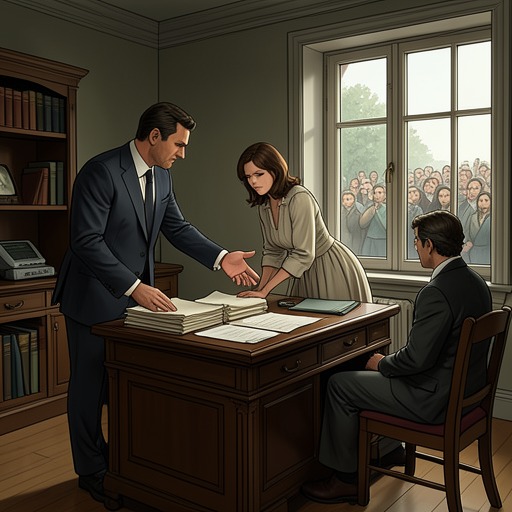
The Board’s inquiry is presented through formal testimony taken in connection with the Chamberlain disaster and through excerpts reproduced in Black Prom: The White Commission Report. The procedure gives the catastrophe a legal and administrative shape: witnesses are questioned about where they were, what they saw, when they received information, and how they identified Carrie White. The form promises factual order, but the testimony repeatedly reveals uncertainty, inference, and knowledge that cannot be explained by ordinary observation.
The Board’s record exists alongside other documentary voices, including The Shadow Exploded and the national Associated Press reports. This layered structure makes the investigation less a single definitive narrative than a contest among institutional accounts. News reports announce that fire is raging at Ewen Consolidated High School and that firefighters have arrived without effect, while the Board later gathers individual memories and official responses into a retrospective explanation. The disaster is therefore remembered simultaneously as an emergency, a crime, a paranormal case, and a civic catastrophe.
Evidence and Testimony
The Board’s evidence encompasses both the immediate mechanics of the disaster and the social conditions that preceded it. In the school-related testimony, Thomas K. Quillan is questioned about his residence and later about the information he received concerning trouble at Ewen High School. Sheriff Otis Doyle states that he was on Route 179, or Old Bentown Road, assisting the Durham constable with an automobile accident when he received a radio transmission from Officer Jacob Plessy at 10:21. Such details establish a timeline while also showing how knowledge of the emergency traveled through imperfect chains of communication.
The inquiry also confronts the failures that made the fire more destructive. The contemporary report states that hydrants in the area had been vandalized and that water pressure from the city mains was inadequate from Spring Street to Grass Plaza. The Board’s reconstruction thus places the school fire within a network of physical and civic conditions rather than treating destruction as the result of telekinesis alone. The damaged emergency infrastructure becomes part of the causal history: rescue efforts were attempted, but the means of fighting the fire had already been compromised.
The Board examines the precipitating cruelty at Ewen High School as well. In testimony concerning John Hargensen’s defense of his daughter, the questioning recalls that Christine Hargensen and about ten peers threw sanitary napkins at Carrie White during her first menstrual period, when Carrie believed she was bleeding to death. Carrie White was insulted, ordered to “plug it up,” and subjected to obscene gestures. The testimony directly challenges attempts to describe the school’s disciplinary history merely as a response to physical or verbal abuse, making the shower-room humiliation part of the disaster’s social prehistory.
The investigation also considers the prom arrangement involving Thomas Everett Ross. Public commentary describes Thomas Ross as Carrie White’s ill-starred escort to the Ewen High School Spring Ball and asks whether he acted as a trigger-man knowingly or unwittingly. Susan Snell says that she had been intended to attend with Ross and suggested that he take Carrie White to make amends for Susan’s role in the shower-room incident. Other commentators dispute this account, calling it a romantic distortion or a lie. The Board’s documentary environment therefore preserves not only actions but competing interpretations of motive, responsibility, and adolescent guilt.
The Trigger and the Disaster
One of the Board’s central problems is identifying the immediate trigger of the catastrophe. Its position on the two buckets of pig blood suspended from a beam over the stage is described as weak and vacillating, even though the available proof is limited. Testimony attributed to Billy Nolan’s associates suggests that Billy removed the operation from Christine Hargensen’s control and acted on his own initiative. This uncertainty matters because the prank was not simply an isolated joke: it links the humiliation of Carrie White to a deliberate conspiracy involving Billy Nolan and Christine Hargensen, while leaving unresolved how much each participant intended or understood.
The disaster itself begins in the gymnasium during the school prom. A fire originating in the electrical equipment of Josie and the Moonglows spreads to the mural of the Venetian boatman and then through the backstage accumulation of old uniforms, books, and papers. The contemporary Associated Press ticker reports that the fire is raging out of control at Ewen Consolidated High School and that emergency crews have arrived without success. The report’s clipped urgency contrasts with the Board’s slower retrospective questioning, showing how an event that was immediate and chaotic becomes, afterward, a sequence of evidence and responsibility.
The Board’s records also preserve the widening geography of the destruction. After the school disaster, Carrie White reaches Grass Plaza, opens a hydrant there, and continues toward Teddy’s Amoco. The testimony of Sheriff Otis Doyle places the first official radio warning at 10:21, while later reports register a disaster of major proportions. These records connect the school, the town’s water system, public roads, and commercial sites into one expanding crisis. Chamberlain is not merely the setting of a single violent scene; it becomes an interconnected civic environment in which damaged infrastructure and delayed information amplify the consequences.
Carrie White and the Problem of Causation
The Board ultimately treats Carrie White’s telekinesis as a possible explanatory factor, but not as a fully established scientific certainty. David R. Congress’s account notes that earlier instances of telekinesis may have gone unrecognized because the ability emerges in moments of extreme personal stress. The same discussion describes a “TK” potential of immense magnitude within Carrie White and presents the tragedy as one that was recognized only after its consequences had become irreversible. The Board’s later scientific language is more cautious, but it cannot remove the explanatory pressure created by the scale of Carrie White’s retaliation.
The inquiry’s questioning of witnesses demonstrates how paranormal knowledge enters official testimony. Cora Simard is asked how she knew it was Carrie White and answers that she simply knew. Another witness is challenged about how anyone could know that Carrie White was present without hearing her. The testimony invokes the unexplained knowledge of Thomas K. Quillan, Cora Simard, and Victor Mooney, suggesting that the survivors’ certainty exceeds what conventional sensory evidence can account for. The Board records this phenomenon without fully resolving whether it reflects psychic contact, trauma, inference, or something else.
The Board also presses Susan Snell about whether she had prior knowledge of Carrie White’s whereabouts. Susan denies it and calls the idea absurd, while resisting the implication that the inquiry is seeking a scapegoat rather than the truth. This exchange exposes the ethical tension within the investigation. Formal questioning appears designed to clarify responsibility, but its adversarial form can also narrow a collective disaster into an accusation against one witness or one perpetrator. The language of evidence and the language of blame are therefore never entirely separable.
Findings, Limits, and Aftermath
The Board’s final conclusion is deliberately restrained. Although an autopsy of Carrie White indicates cellular changes that may point to paranormal power, the Board finds no reason to believe that a recurrence is likely or even possible. This conclusion refuses both sensational certainty and complete dismissal. Carrie White’s ability is treated as a possible biological or paranormal condition, but the official record declines to declare that another disaster will follow.
That caution has political and moral consequences. The prospect of isolating the TK gene raises the question of whether children with such potential would be removed from their parents at puberty and confined for life. The Board has worked hard, according to the surrounding commentary, to persuade the public that the Chamberlain nightmare was a complete fluke. Its conclusion therefore does more than close a case: it helps define what society is permitted to fear, what it must regulate, and what it may choose to regard as an exceptional accident.
The State Investigatory Board of Maine consequently occupies an ambivalent position in the narrative. It preserves crucial facts about the blood prank, the school fire, vandalized hydrants, emergency communications, witness certainty, and Carrie White’s possible telekinesis. At the same time, its report cannot restore the dead, settle every disputed motive, or make the disaster morally simple. Its official conclusion brings the inquiry to an administrative end, but the surrounding documents leave readers with a larger question about whether public institutions can explain catastrophe without disguising the social violence and shared failures that made it possible.